Filters Removed when adding a column via "show more columns"
With "new style" table reports, if I apply dynamic filters or use the search bar to filter the report, and then add a column (by hovering over a column header, using the "..." then choosing "show more columns" and hitting "apply"), the column gets added but all those filters get removed. The search term remains in the search box and dynamic filters that were applied still appear to be selected in the UI (shows selected still at the top) but they are not. The filters are removed, and you have to clear and re-apply your filters. It trips me at least once a day and it's driving me nuts...I put in a support case in April, eventually QB closed it and said they tied it to a bug, but I can't be the only person that this is bothering... I understand that QB is probably/hopefully working on this and I just need to be patient. I guess I'm just looking to commiserate in the meantime with any else that is getting really annoyed about this. Can I get an AMEN??91Views3likes1Comment
summary report totaling issue
Hello, I am a newbie trying to learn and I was hoping someone would be able to help me figure this out, if possible. I have a summary report (attached) that we use to look at "item number" totals for an active job. Our foreman enter a daily log and chose the different item numbers that they are doing that day and enter whatever quantity installed. We have the unit price of the "item number" and the "bid quantity" that was projected. The problem is that the "bid amount" calculates the "bid quantity" every time that "item number" is used in a daily. For example; if they use 001 in 4 dailys and installed 453 SY it would calculate the "bid amount" as 1838 x 4 =7352 - but the "bid amount" should just be 3.13 x 1838 = 5752.94. so it was making that total way off. BUT the "Quantity Installed" calculates the "Revenue" correctly. 1812 x 3.13 = 5671.56. I was told for this that the "Bid amount" should be changed to Maximum and that will just give you the total of the "unit price" and "bid quantity" which it does! Great! The only problem now is that the total at the bottom of the column of "Bid Amount" is just giving the Max amount not a complete total. I know that changing it to max will no longer give me a total of that column so I am not sure what I can do with this summary report that will give me a "bid amount" column total that is accurate? Is there a formula that can be added to this report to override that? Your help would be much appreciated! Thank you, Carol86Views2likes1Comment
Timeline Reports showing outside of date range
Hello, I am trying to create a Timeline Report for data that has a start date and due date field. The start date of my report is January 1, 2026 and the end date is December 31, 2026, but the Timeline displays December 2025 through January 2027. Filters on the report are set to only pull items that have a Start Date on or after January 1, 2026 AND an Due Date on or before 12/31/2026. The report is pulling the correct information, but the extra weeks/months show on the report and I would prefer they do not. Odd thing, if I change the Start Date range of the report view to February 1, 2026, it accurately starts at that date but still reflects the same amount of records set by the filtering criteria. Am i missing something?Solved113Views2likes1Comment
Unduplicated people summary report
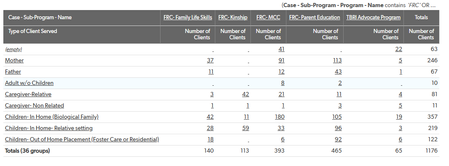
I built this summary report and need help filtering out duplicated clients. This report is built on the "Case Clients" table that is the many-to-many table connecting "People" to "Cases". I need this report to only show unduplicated people within each column. I have not used Help!189Views1like3CommentsRunning totals for charts
Hi all Want to share my solution on how to create running totals for charts. QB does not support running totals for charts, only summary reports. QB Junkie has a really good solution to create running totals using the query formula but as stated in her video it only works with small data sets and it is really memory intensive. QB has posted a solution to use the report API function to build a new running totals table from a summary report but I found this to be even slower and it does not give the user live updates. I use own table relationships that allows me to chart large datasets quickly and live. Below is an example of this application but I use this for many other data sets that do not use dates so do not get stuck on the dates table step. Create a dates table. I made the key a text field so that i can create the reference field. Record ID is also an option but a bit harder. My key was "<date>-<project no>" Create an own table relationship I use pipeline's Make Request action to create and maintain this table with its key and related field value. This is a Jinja code on Exchange I borrowed so let me know if this is of interest to anyone. It super-fast but again not a requirement. Summarise the values I want into the dates table Create a blank formula field and this will be my running total Summarise the blank formula field i created in step 6 above. I use the own table relationship for this. Go back to the blank formula field in step 6 and write a formula that adds the summarised value in step 5 to the summarised value in step 7. BUT I found this needs to be via an if statement and can't be a simple addition as it fails randomly. Maybe a bug in QB but I found my way around this and its now super reliable. My if looks like this If( Nz([Field in step 5]) + Nz([Field in step 7]) <> 0, Nz([Field in step 5]) + Nz([Field in step 7]), Nz([Field in step 5]) <> 0, Nz([Field in step 5]), Nz([Field in step 7]) <> 0, Nz([Field in step 7])) Thats it. Fast reliable running totals to draw charts! See screenshot below173Views1like1Comment
Secure link to a report
Secure links to reports are mentioned in the Quickbase documentation and multiple places on the Quickbase website, but I can't find a single example. I understand how secure links can be made for forms and records and know there are examples of this in the Exchange. But there is no example of how to create secure links to reports. I figure one way to do it is create a key generator field, then an ask the user report, and filter to records where the result equals the key value. But just wondering if anyone has any other, better ideas?307Views1like7CommentsReport help
Hello! I'm diving into someone else's app, trying to wrap my head around their reporting needs. The previous admin created several "checkbox" fields that are in reality, types of answers to a master field. I need to tally each checkbox and ideally, I'd love to get this all on one report. I theorize the reason they did individual checkboxes vs. one multi-select field is because, in my own experience with multi-select, a report of such won't cleanly count how many times each item was selected, but will report out instances of the specific combination of what was selected. In my example, I'm tallying types of support received, where there are 10 sub-types as check-boxes, so ideally this report shows the exact count of each type of service counted. Please and thank you!Solved313Views1like6Comments
Kanban records per column limit
We have customers who have “an order” of up to 300 items. The order is initiated via connected channel to Box. A CSV file listing the items is dropped in the Box folder and are tracked in Quickbase. The Kanban report is desired but is limited to 100 records (items) per customer. Is there any known work around for the 100 maximum number of cards (records) per column in a Kanban report? I need 300 in a column. Thanks, Bruce B.115Views1like1Comment
Gauge Report - Wrong Percentage
Hi! I'm creating a gauge report that shows the percentage of POs Invoiced/Current Project Budget (aka Percent Consumed). This report is going on a dashboard that has a dynamic filter for Project Priority. After lots of trial and error, I decided to create summary fields in a parent table called "Universal Reporting Record". The summary fields specify the percentage for each priority... 1, 2, 3 and the combination of all three as All. I am then using a formula in the gauge report to specify which Percent Consumed field should be used depending on the priority: The percentage for "All" should be 13.4%, but it continues to show 17% and I cannot figure out why. The other priorities (1, 2, and 3) show correctly as the dynamic filter is changed. The calculation is done on $s Consumed/Total Budget. These are the same fields used in the summary table mentioned above, just different labels for the dashboard. Here are the results for Project Priority = 1 which are correct: Any help is greatly appreciated!!502Views1like8Comments